I did 32 million views in one month
It is easier than you think. Anyone can do it. Just read this:
Contents
This month I did 32 million views across Instagram, X (formerly Twitter) and Threads:
770,000 on Instagram, 6.7M on X and 24M on Threads.
I have been on X for four months. On Threads, six weeks. On Instagram, three weeks.
The real secret is being consistent. Everything else is what follows.
These are my stats for this month
I hate articles where somebody explains how to do something and never shows a single number. So I am starting there.
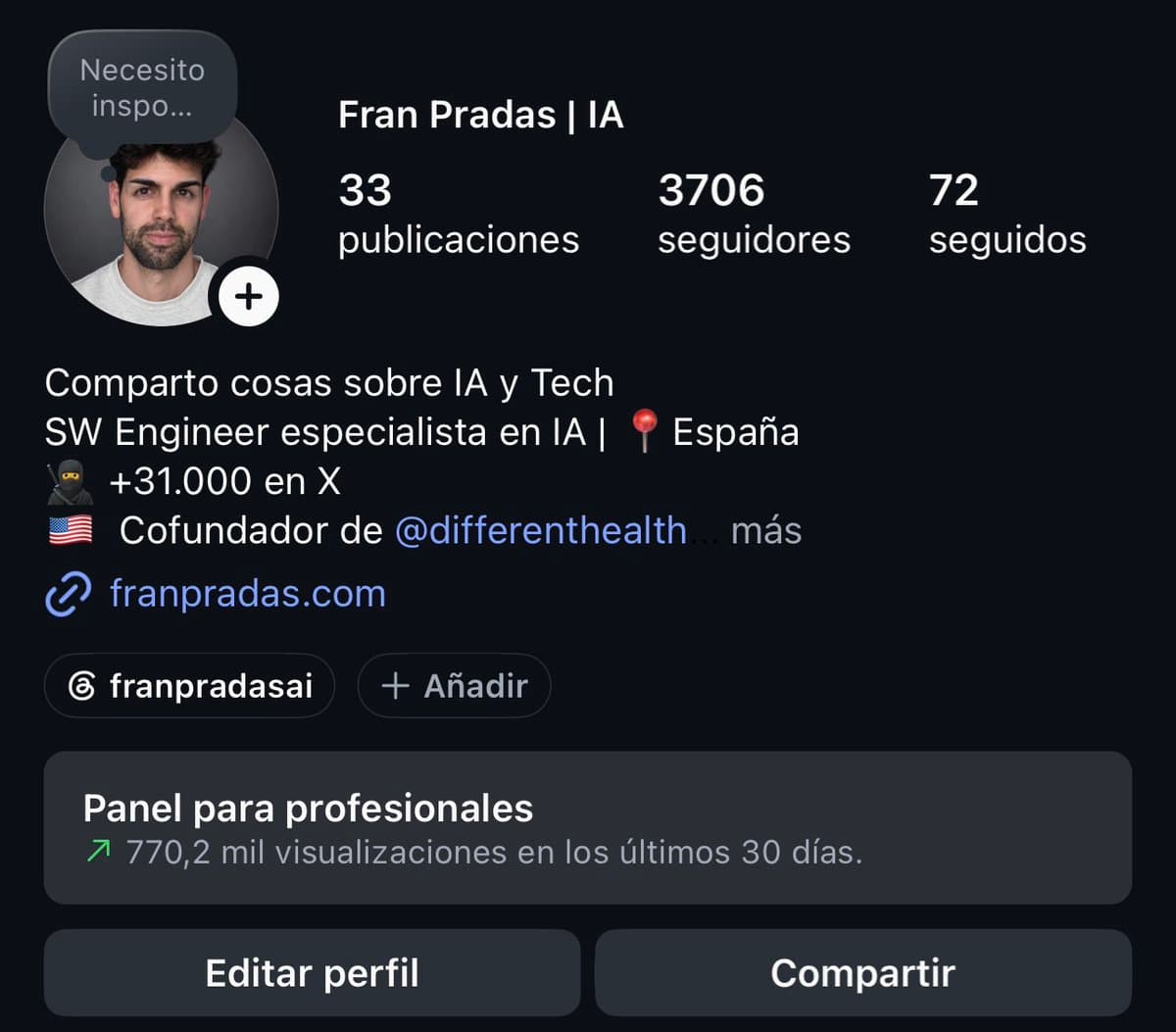
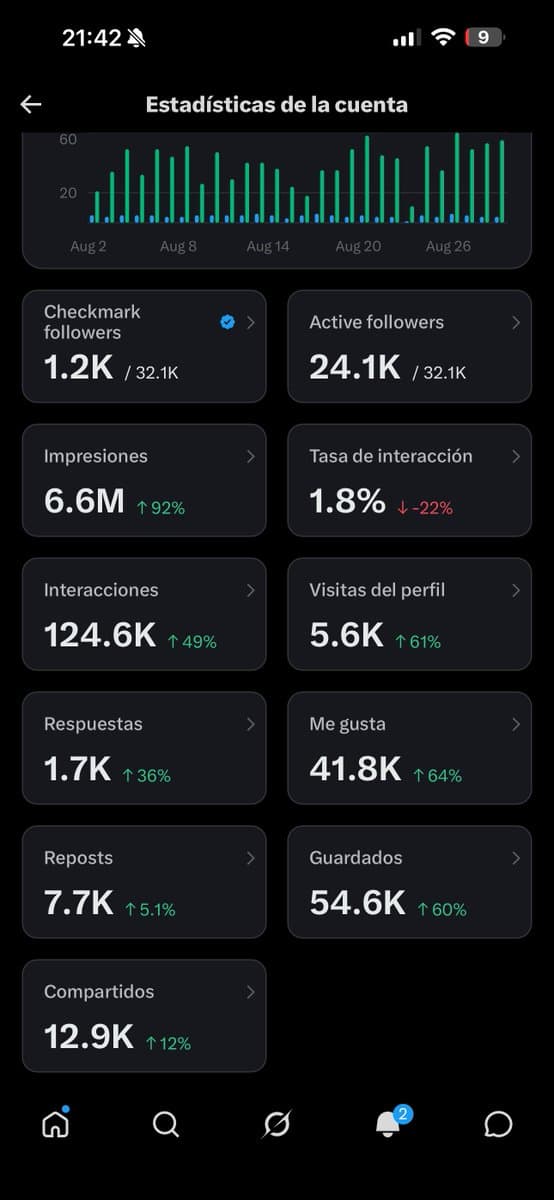
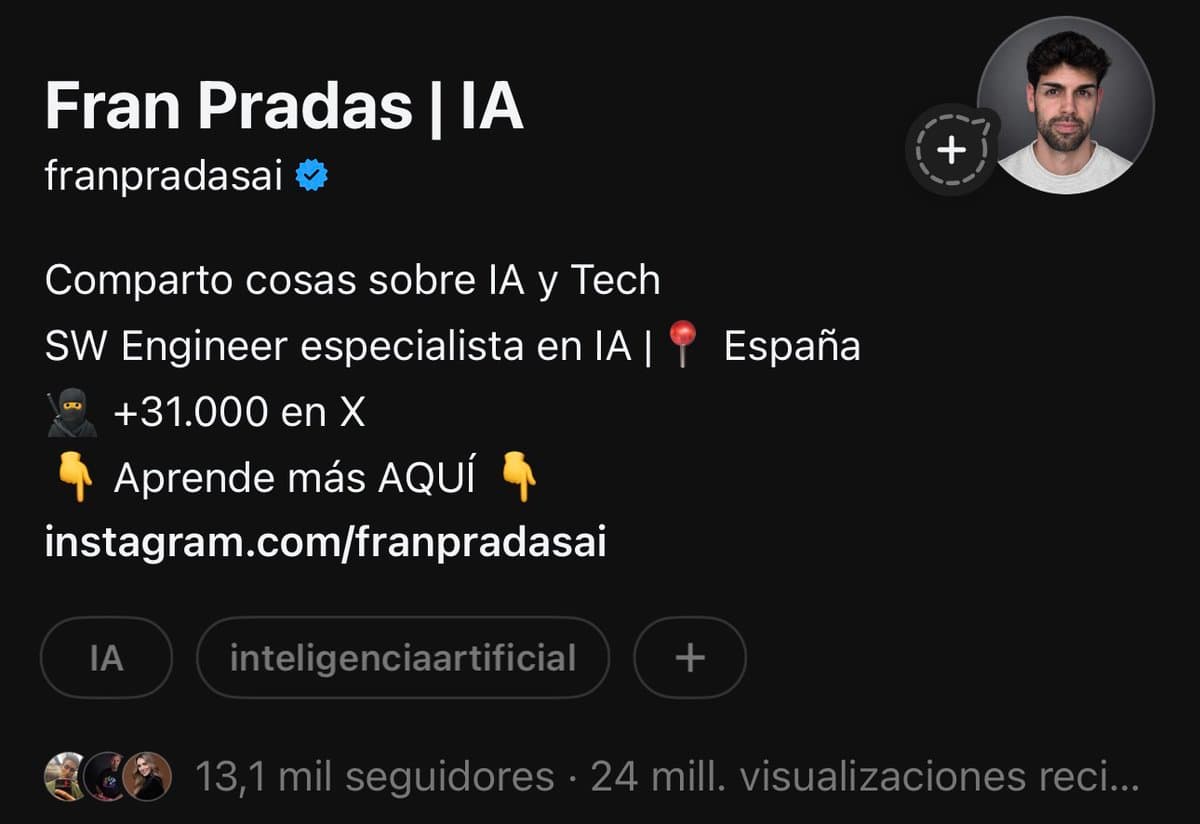
Two things matter most here. The first, that with followers you can sell anything: they make your business and your products far easier to discover. The second, that you no longer need followers to reach people.
Because the change is this: until recently your post was seen by your followers and little else. Now every platform distributes by recommendation: they test what you publish on a handful of people who do not follow you, and if it works they widen it.
On top of that, every social network has changed its algorithm to favour whoever is starting out. That is why there are so many YouTubers complaining. They have 4M subscribers and nobody sees them. Take advantage of it.
1. Where do I start?
This is the part almost nobody tells you, and it is what stops 90% of people. If you are embarrassed to start, which is normal, and above all if you cannot bring yourself to film yourself, follow these steps:
I say this with affection: nobody cares about you. The first day you post something not even your partner will see it. Nobody is waiting for you to slip up. Nobody is going to look at you funny at work. You are simply invisible.
Step 1, faceless X. No photo of you, no real name if you do not want one, just a niche and an account. Here you learn the only thing that matters at the start: writing hooks. You write, you post, you look at the impressions, and you repeat. It is a simulator. Stay here until you have 4,000 followers.
Step 2, X with your name and your face. It is exactly what you were doing before, but now the credit is yours. And this is where DMs, clients and opportunities start arriving. Followers on a faceless account are just as good for partnerships, but they do not give you the same authority.
Step 3, Instagram but without talking straight to camera. This is where people get stuck: they think they have to be talking to camera from minute one. No. Start with videos where you are seen from behind, walking, typing on your laptop, cooking, at the gym, travelling. On top, the text, which is the hook you already know how to write from step 1. You are on camera without being on camera. Things that work really well are "10 things about…" and you leave the video running for 5-7 seconds. Down in the caption, a "Comment X and I will send you Y".
Step 4, now yes, talking. By the time you get here you will have a clear niche, hooks validated with data, the habit of being seen and, above all, the certainty that absolutely nothing happens. Do it gradually and it will cost you far less. I tried to jump from 1 to 4 and lost months.
2. What to talk about: the niches that go viral
I am going to be blunt, because this saves you months. The two niches that go viral most right now are finance and artificial intelligence. It is no coincidence: both hit the same nerve, money and the fear of being left behind.
But I know what you are thinking: I do not talk about that, I make travel videos, camper van videos, cooking videos. Perfect. Then the rule is a different one, and it is just as important: nobody wants to see your life, they want to learn something.
If you do travel, do not show your life. Nobody cares about your breakfast in Bali, or your partner watching the sunset, or your backpack. Show interesting things about that place. Teach. Educate. Explain.
- “My day in Lisbon”, no. “Lisbon has a lift from 1902 that used to be the back yard of a house”, yes
- “Road trip through Japan”, no. “3 things you can do for free in Tokyo that not even locals know about”, yes
The winning travel format is tips and explaining things, not a personal diary. You are the one who teaches, not the protagonist. And this holds for any niche: the content is not about you, it is about what the other person takes away.
3. How to find exactly which video to make
Here is the real trick. Do not invent ideas: find the questions people are already asking.
3.1 X advanced search
The first is the best of them all and almost nobody uses it: advanced search on X. It has operators that let you filter by a minimum number of retweets, likes or replies. In other words, you can ask it to show you only what went viral. You type them straight into the search bar.
- min_retweets:300, only posts with 300 retweets or more
- min_faves:1000, only posts with 1,000 likes or more
- min_replies:50, only posts with 50 replies or more
- lang:es or lang:en, the language of the post
- since:2026-08-01 and until:2026-08-31, the date range
- from:handle, only from that account
- filter:videos, only posts with video
- -filter:replies, drops replies and leaves original posts
- -filter:links, drops posts with a link
And the combinations that really pay off: “prompts min_retweets:300 since:2026-08-01 lang:es” for what is working in your niche in Spanish; “prompts min_retweets:300 since:2026-08-01 lang:en” for what is already viral in English and has not reached you yet, which is a gold mine; “from:accountyoulike min_faves:1000” for the best posts of the biggest account in your niche; and “from:your_handle min_faves:500” for your own posts that worked and you no longer remember.
Lower min_faves if your niche is small and raise it if it is huge. Fifteen minutes of this and you have 30 validated hooks in front of you.
3.2 Google autocomplete
The second is Google. Type your topic and do not press enter: look at the autocomplete, because that is literally what people search for. Scroll down to “People also ask”, where every question is a video. Search “site:reddit.com [your topic]”. And open Google Trends to compare two ways of saying the same thing and keep the one that is climbing.
3.3 Reddit, for niches
The third is Reddit, and it is the best one for niches. If you make camper van content, go to r/vandwellers, r/CamperVans or r/furgoneteo and sort by Top of the year. The first 30 threads are, literally, your content calendar. And better still: read the most upvoted comments, because that is where the hooks are already written by other people.
3.4 Instagram by location
The fourth, Instagram by location, is gold for travel: search the country or the city you are in, open the Places tab and then the most popular ones. You are looking at the most viral content from that place, sorted by the platform itself.
3.5 Search-bar suggestions
And the fifth is the search suggestions on TikTok and Instagram: every suggestion is a real search by a real user, and every one of them is a video.
With these five methods you have 30 validated ideas in an afternoon, and you invented none of them. They all come from people who are already looking for that.
4. The 50/50 rule: copying is fine
I am going to say something that will make a lot of people uncomfortable: 50% of your content you should copy. From trends, from content that has already worked, from accounts bigger than yours, from accounts in your niche in other countries.
You are not stealing: you are using information. A post with 2M views is a data point, and that data point says “this angle works”. Ignoring it out of pride is throwing money away.
But with two rules you cannot skip. The first: never an exact copy. Always change something, the example, the time frame, the list, the angle, the music, your own experience on top. If you copy word for word, they will take the post down for duplicate content, and rightly so.
Copy the structure, not the words.
The second: copy from other languages. This is what works fastest and almost nobody does it. What is viral today in English, Portuguese or French has not reached Spanish yet, so you are literally weeks ahead. Take the angle, translate it and adapt it to your context, with local examples and prices in your currency. Do not reinvent the wheel: the wheel is already invented, in English, with 4 million views.
The other 50% is where you really put yourself on the line. That is where you look for a new viral that does not exist yet, where you tell your experience, your numbers and your failures, where you build authority, which is the only thing that cannot be copied. The copied 50% gives you reach. Your own 50% gives you a business. Both, always.
5. How each platform's algorithm works
Now the technical part. And here I am going to separate what I know from what I believe, because they are not the same thing.
I will start with Threads, and with the bad news. The Threads algorithm is the worst of them all. And I do not say it out of spite: I say it because it does not reward quality, it rewards brute consistency. Look at this:
It is the same sentence, copied and pasted, every day, for months. And look at the numbers on each post: 1,500 likes, 1,300 likes, 1,400 likes, 266 replies, 256 replies, day after day with the same text. And it works: the account is past 200,000 followers.
That does not exist on X. X detects duplicate content and buries the post. Threads simply does not penalise repetition: every day it hands the same text to new people as if it were the first time. That is why I say its algorithm is the worst, because it rewards showing up, not contributing.
So why is Threads such a good platform? Because reaching new people is ridiculously easy, take advantage of it. It is the network where the least effort reaches the most people who have never heard of you: 24M views in a month. Threads distribution, if you know how to exploit it, is completely absurd. You can have 10,000 followers and have one post without a single like, or churn out posts with over 1M views.
On Instagram they are watching you, and that changes everything. On X they read your words; on Instagram they see your face, hear how you speak and notice whether you know what you are talking about or are reading a script. A month of being seen on video builds more trust than a year of being read. Instagram is not where you will get the most reach: it is where people decide whether they trust you. And without trust there is no sale.
With X there is nothing to guess, and this is pure gold: in August 2026 they published the whole code of their recommender, the one they call Phoenix, with the default weights inside the repository. This is what each thing somebody can do with your post is really worth.
Read it again, because it completely changes how you should be posting. A like is worth 0.5 and a reply is worth 5: ten times more. And if that person and you follow each other, that same reply is worth 20. The most expensive thing on the whole table is somebody copying your link and sharing you elsewhere, also 20, forty times a like. Everybody is out there asking for likes, and the like sits near the bottom.
- Write to be replied to, not to be liked. A reply is worth 5 and a like 0.5, and if you follow each other it goes up to 20
- Reply to every comment on your posts: each reply of yours that keeps the conversation going is among the most expensive signals in the system, and it is free. I would often answer somebody's reply with a question, which frequently forced another reply.
- Write things that get forwarded. Being shared has three prices: copying your link is worth 20, sending you by DM 5 and hitting the share button 2. The first is the heaviest thing on the whole table, forty times a like
- Being followed off the back of a post is worth 4. Someone opening your profile, on the other hand, no longer adds anything: in this version it weighs 0
- Opening your link is worth 0.2, less than a like. Taking people off X is expensive, so the link goes in the reply, not in the post
- A report subtracts 234, which is 468 likes down the drain. Polarising works; insulting sinks the account
- Being muted subtracts 58.8 and “not interested”, 43.2. Posting too much sets them off
Instagram, on the other hand, publishes nothing, so what follows are my own hypotheses from looking at my data, and I may be wrong. I do not think it differs much from how X works. I believe what weighs most is being shared over WhatsApp or DM, because it makes a person come back to the app. Then sharing to stories, because whoever shares puts their reputation on top of your content. Then comments, which require stopping, reading, thinking and writing. It all comes down to retention.
What weighs most is whatever keeps the user longer on the platform. Keep that in mind every time you are about to post.
6. Groups and the comments that actually count
One strategy you can follow is to talk to somebody with the same number of followers as you and start a group. When you post you send each other the link, and you like, comment, save and repost. This, without a doubt, increases reach on X.
On Instagram I have no idea, but keep it in mind.
All of this is visibility, which is the only thing that is genuinely scarce at the start. Your content can be brilliant: if nobody sees it, it is a private diary.
And now the part almost nobody does well: commenting. Comment on other creators as if it were a post of your own: three or four lines, with a fact, an experience of your own or a nuance you disagree with. Make it add something and make people read it, because that is how you pull in an audience from other posts and other creators.
7. When to post
You have to measure this yourself, but I will give you my starting point in Spanish time. On X I usually post from midday until ten at night. In windows of at least 2 hours. About 4-5 posts a day.
It seems that the more you post the less reach you get, on a decreasing scale, but this works for me, and for my colleagues too.
On Instagram, since I am really just starting, I do not have much of a clue, but what I do know is that you have to try to post every day. Posting once a week is useless.
Think of a snowball: people who see your older videos go into your profile, and see your newest one. After 48 hours, that post has already run out of steam.
8. Crossposting: write once, publish everywhere
This is what has saved me the most time so far. Everything you write for X goes to Threads. And what works on X works on Threads, not the other way round.
Same text, same format, same hook, zero adaptation.
Do not do it by hand copying and pasting, because you will quit within a week. I use Typefully: you write once, you schedule, and it publishes to X, Threads, LinkedIn and Bluesky at the same time. Same with vertical video: a Reel is a TikTok is a Short. One video, three platforms. If you post on a single network you are doing 100% of the work for 25% of the result.
Remember to create a Facebook account too, so that what you post on Instagram gets published there as well.
9. How to structure a post on X
The substance matters, but the format is what decides whether anybody gets to read you. The shorter the better: if it fits in fewer words, it goes in fewer words. And the hook, a single sentence; if it takes two lines, you have already lost half of them.
Always keep in mind that people do not want to read. People are lazy by nature. Even the video you make: the longer it is, the less likely they are to watch it all the way through. The less retention, the less it gets distributed.
This is what I would advise for a post on X:
- Red emojis at the start. 🔴, 🚨 or ❌ break the grey wall of the feed, and the eye goes there before the brain decides anything
- BREAKING or NEW in the hook. It is somewhat throttled and does not pay off like it did a few months ago, but it still works better than leaving it out
- One word in CAPITALS among the first five. HEADS UP. HUGE. BRUTAL
- Let the post breathe. One idea per line and a break in between. Nobody reads a compact block on a phone
- Close by asking for something: the link below, a question, a “has this happened to you?”. One reply is worth ten likes
What I am telling you here is VERY IMPORTANT. The CTA “follow me”, “drop a like”, “repost it” pays off far more than it looks, and it works the same in a written post as in a video. I noticed it on Threads, when some thread CTAs, after 10-15 posts, had over 100 likes.
10. Anatomy of my 10 most viral posts
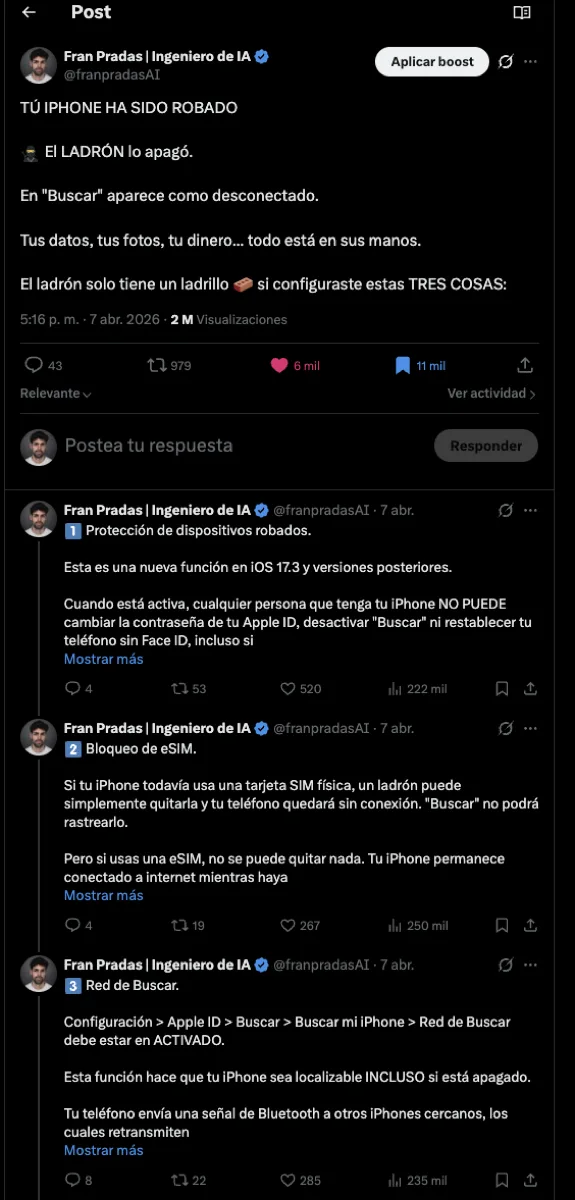
10.1 My 10 most viral posts on X
I took my 10 highest-impression posts of the last 90 days and looked at what they have in common. These are the data, not my opinion.
- 1M, RESET YOUR LIFE IN 48 HOURS
- 537K, 🔴 The iPhone can do BRUTAL things
- 479K, 🔴 HEADS UP: do not tell CHATGPT to “find me the best flight”
- 402K, Your AirPods Pro are an FDA-approved hearing aid
- 398K, 🔴 HUGE: some Chinese labs just blew up paid AI video
- 360K, 🔴 HEADS UP: my parents save money at the supermarket with AI
- 336K, 🚨 HUGE: I asked Claude to improve my LinkedIn profile
- 285K, 🔴 YOU DO NOT NEED ANYTHING ELSE
- 283K, 🤯 Ask CLAUDE for your app's ARCHITECTURE on a single page
- 247K, 🚨 HEADS UP: this has REVOLUTIONISED the property industry
The hook is four lines and not one more: nine of the ten fit in four lines before the first big break, and there is a mechanical reason, which is that on a phone the feed cuts the post right there. If your promise is on line six, it does not exist.
Six of the ten open with a red emoji. It is not magic: the feed is a grey and white wall, and red is the only thing that breaks the visual pattern. Use it with your head, though: if ALL your posts open with 🔴, you stop breaking the pattern and become the pattern. Seven of the ten have a word in capitals among the first five words.
They close the hook with a promise and an arrow: “here are the 7 exact prompts I used 👇”. It is not decoration, you are telling the reader there is something underneath, and it is what turns “seeing” into “opening”. Opening the post scores separately from reading it, so the arrow is literally a lever on the algorithm.
Four of the ten use a loss frame rather than a gain frame: “you paid $250 for your AirPods and never switched it on”. Losing something hurts more than gaining it, and that hurt turns into clicks.
And a hook that works gets reused. Look at number 1: I posted that same one again six weeks later, swapping only “IN 48 HOURS” for “BEFORE SEPTEMBER”, and it pulled another 974K. That is why it is not in the list above: it is the same post twice, and counting it twice would be cheating at solitaire. A validated hook is not a consumable, it is an asset: keep the ones that work in a document and rotate them every four to six weeks changing the time frame or the example.
And now the uncomfortable number. Post number 1, with 1M impressions, has 936 likes: 0.09%. Number 9, with 283K, has 5,800 likes: 2.05%. Twenty-three times the ratio with a quarter of the reach. This is not an anomaly, it is exactly the next point in the article.
10.2 My 10 most-played reels on Instagram
On Instagram the format matters even more than the topic, and I saw it when I audited all 27 of my reels at once. These are the ten most played.
- 276K, Founder trying to work in the daytime
- 95.9K, My first app shipped
- 68.1K, Backend in 2026: learn these 9 skills
- 44.8K, “I have no certifications for my CV”
- 38.1K, My brain in 2026
- 34.1K, Add security to your apps
- 21.4K, POV: my mornings with Claude
- 19.6K, 5 free AI certifications for your CV
- 17.6K, FOCUS: the road is hard
- 16.4K, It is 3AM but you have Claude Max
Eight of the ten are the same format: a wide shot of my setup, no talking, with one big line of text over it. No face to camera, no mic. My reels of that kind average 30,000 plays.
And now the negative number: every time I get in front of the mic to explain something, performance drops by five to ten times. My talking-to-camera videos average 9,000, and 3,400 if I remove the only one that worked. It is not that talking to camera does not work; it is that it opens like an explanation instead of like a conflict. (This is something to fix. I have given you exactly the explanation Claude gave me when I used Computer Use.)
The other pattern is about topic, not format. When the video loses the AI or founder angle and settles into lifestyle (coffee, sleep, rest) it falls to 2,000 or 4,000. The same night-time shot with Claude inside the joke does 16,400; without Claude, 2,700.
And the uncomfortable number, the same one as on X but the other way round: 830,000 accumulated plays have left me 3,300 followers. That is 0.4%. Plays tell you plenty of people discover you; followers tell you whether anybody understood why they should come back. Eleven of my twenty-seven reels go past 10,000 and another eleven do not reach 5,000: that is not luck, it is that there is one format that works and, according to the AI, it seems I dilute it every time I try something else.
So I will have to squeeze the wide-shot-with-text-on-top format harder.
11. The three sales funnels, applied to social
None of the above is worth anything if you do not know what each post is for. If you only publish viral content, you will get millions of views, but they convert to followers at a lower rate than an educational post. If you only publish educational content, you will build authority, but you give up the top of the funnel where you catch the most eyes. If you only publish sales content, you will get zero views and zero euros. You have to combine all three, always.
TOFU is content for people who do not know you exist to discover you: maximum reach, minimum specificity. The “RESET YOUR LIFE” posts, the lists of 300 tools, the iPhone trick. The metrics that matter are impressions and shares; the ones that do not matter are likes and sales. You do not sell here, you exist here: it is the shop window. My number 1, with 1M impressions and 0.09% likes, is perfect TOFU, and it worked exactly as it should. This is also where the copied 50% I told you about earlier belongs.
MOFU is educational, niche content for somebody who already knows you a little: fewer impressions and far better engagement. The HTML architecture post, the repo-turned-into-a-prompt one, the tool lists. The metrics that matter are saves, replies and profile visits. This is where somebody goes from “ah, a funny post” to “this guy knows his stuff”. My number 9, with 283K, 2.05% likes and 1,200 reposts, is pure MOFU: fewer people, but the right people.
BOFU is specific content, uncomfortable to write, with few impressions and an offer attached: the real case with numbers, the “this is how I did it for a client”, the “this is what I sell and what it costs”. The metrics that matter are clicks, leads and sales, and nothing else. You are going to get 10 times fewer impressions and that is normal, it does not mean you failed. Here is the mistake everybody makes: they publish BOFU, see 3,000 impressions instead of 300,000, panic and stop doing it. BOFU is not measured in impressions, it is measured in money.
In my case my "BOFU", and I put it in quotes because over four months almost all of it has been partnerships, is Uniaverso, my AI academy (we are testing whether the model works, opening soon).
What works for me, over 10 posts: six TOFU that fill the top, three MOFU that convert whoever is already inside and one BOFU that charges. And the part almost nobody gets right: the TOFU and the BOFU have to talk about the same thing. If your viral post is about iPhone tricks and what you sell is AI consulting for companies, you have brought in a million people who are never going to buy from you. The viral has to be the light, mass-market version of what you sell: same conversation, different depth.
12. Audit your accounts with Computer Use
Everything you just read came out of reading my own data. And I did not do it by hand: the AI does it for me, with Computer Use. You hand an agent control of the browser, it goes into your analytics, reads your posts and hands you back a diagnosis and a plan.
You need Claude Code or Claude Desktop with the Claude for Chrome extension, and to be logged into your accounts in that Chrome. It works the same with Codex: the prompt is identical, the only thing that changes is who drives the browser. The prompt is right below, in two versions: one for what you write and one for what you film, because they are not audited the same way. Swap in your handle and your niche.
And do not only point it at yourself. The same agent covers point 3: tell it to go into X search with the operators above, or into the big accounts in your niche, and bring back the thirty posts that worked best this fortnight along with the pattern they share. It is the boring part of finding content, done while you do something else.
I run this every two weeks. It takes a few minutes and it hands back things you would never see looking at your posts one by one. Two weeks later you run it again and compare, so it turns into an improvement loop that does not depend on your intuition. Every fortnight and not every month for a reason: in a month you have time to publish thirty posts following a pattern that does not work, and in fifteen days you find out halfway.
13. My total numbers
The ones above are this month's. These are the full dashboards, exactly as each app shows them to me, so you do not have to take my word for it.
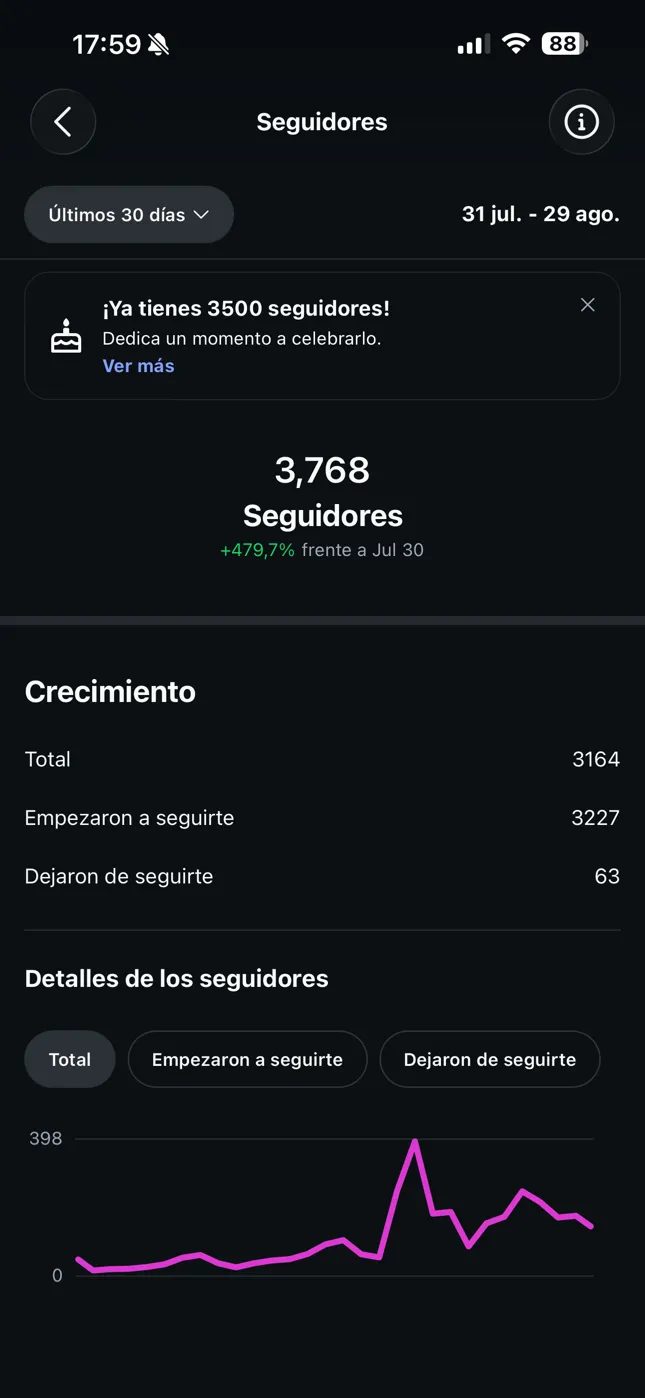
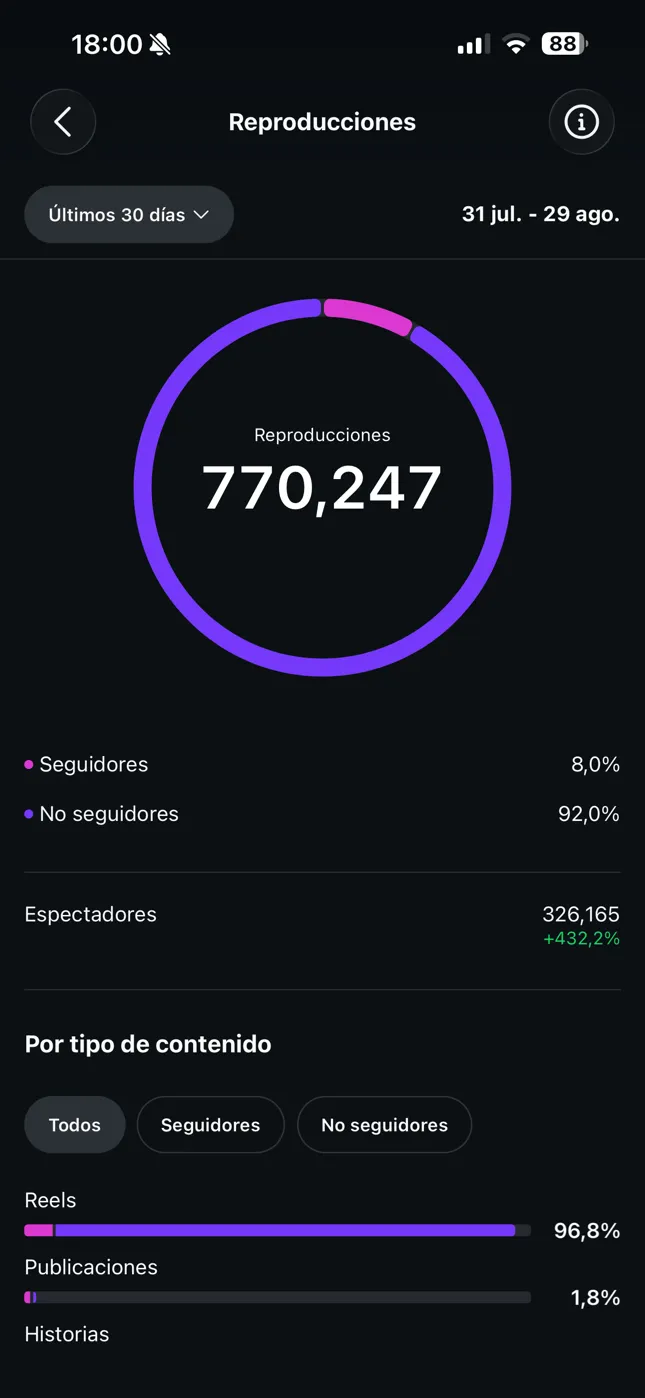
Instagram, over 30 days: 3,768 followers, up 479.7% on the previous month, with 3,227 gained and 63 lost. And 770,247 plays, of which 92% come from people who do not follow me. Reels are 96.8% of everything that gets watched; posts, 1.8%.
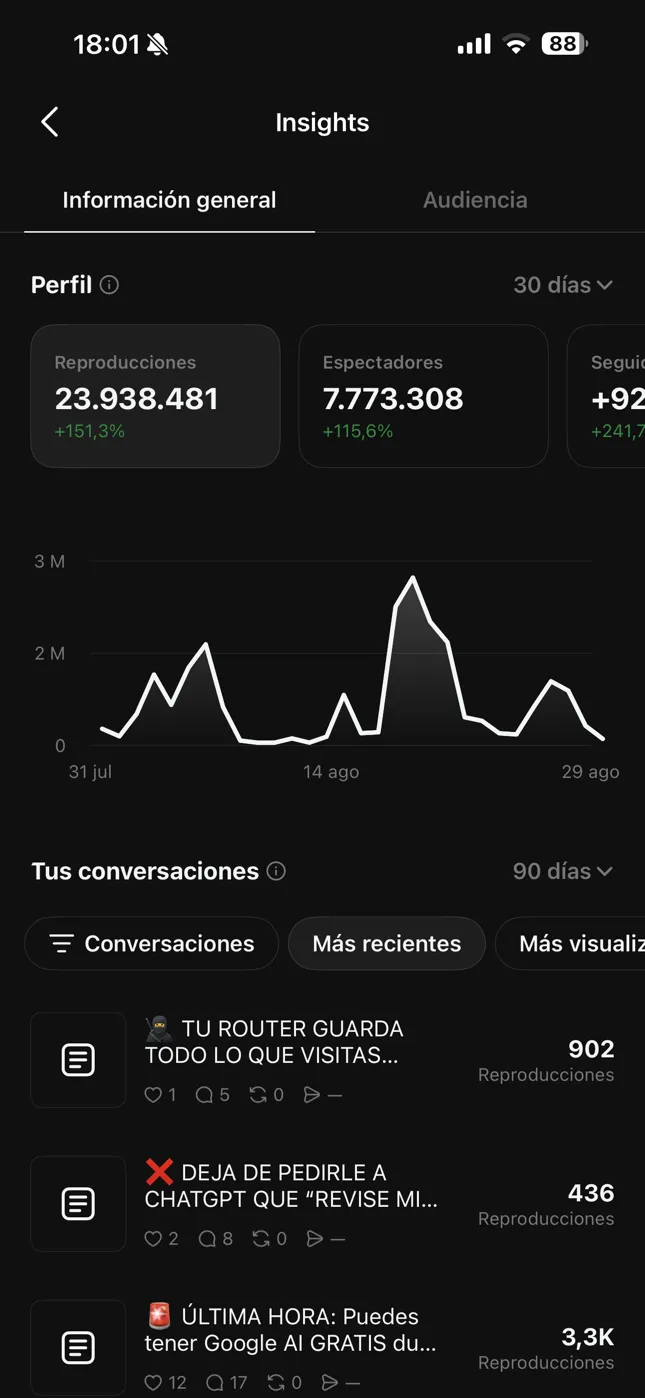
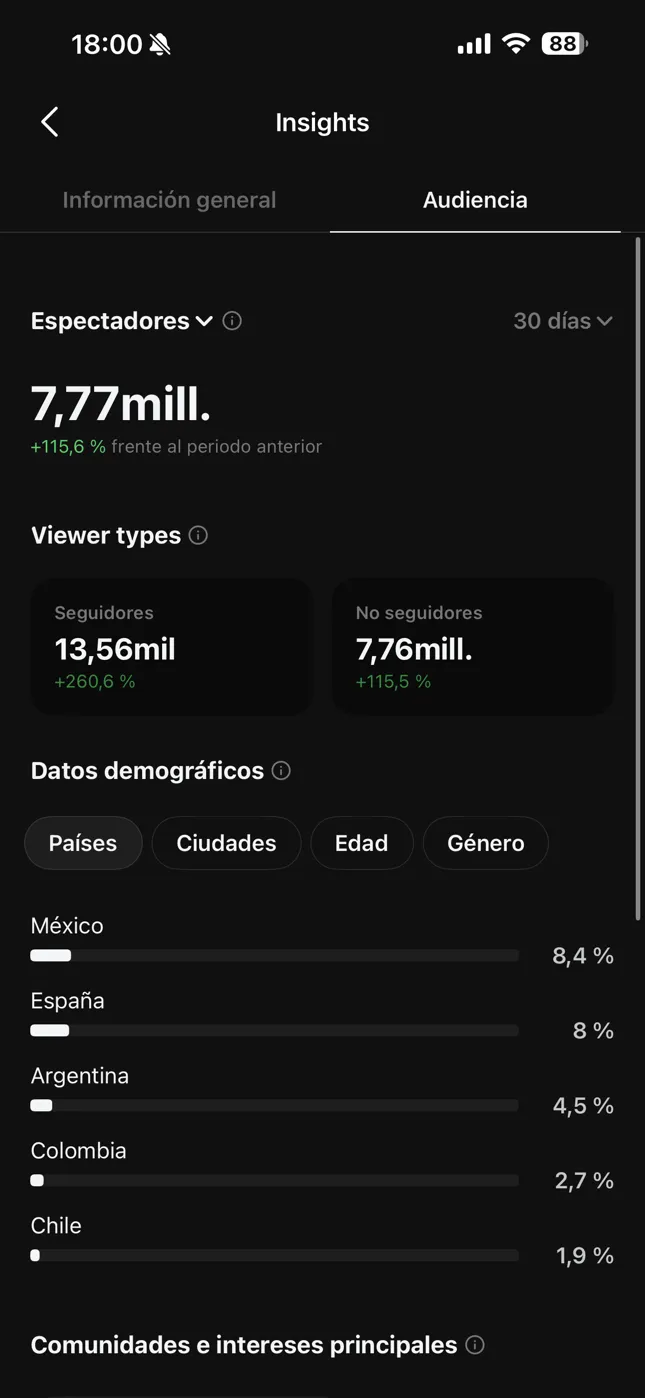
Threads, over 30 days: 23,938,481 plays, up 151.3%, and 7,773,308 viewers. Of those viewers, 13.56 thousand follow me and 7.76 million do not. By country Mexico leads with 8.4%, then Spain with 8%, Argentina, Colombia and Chile.
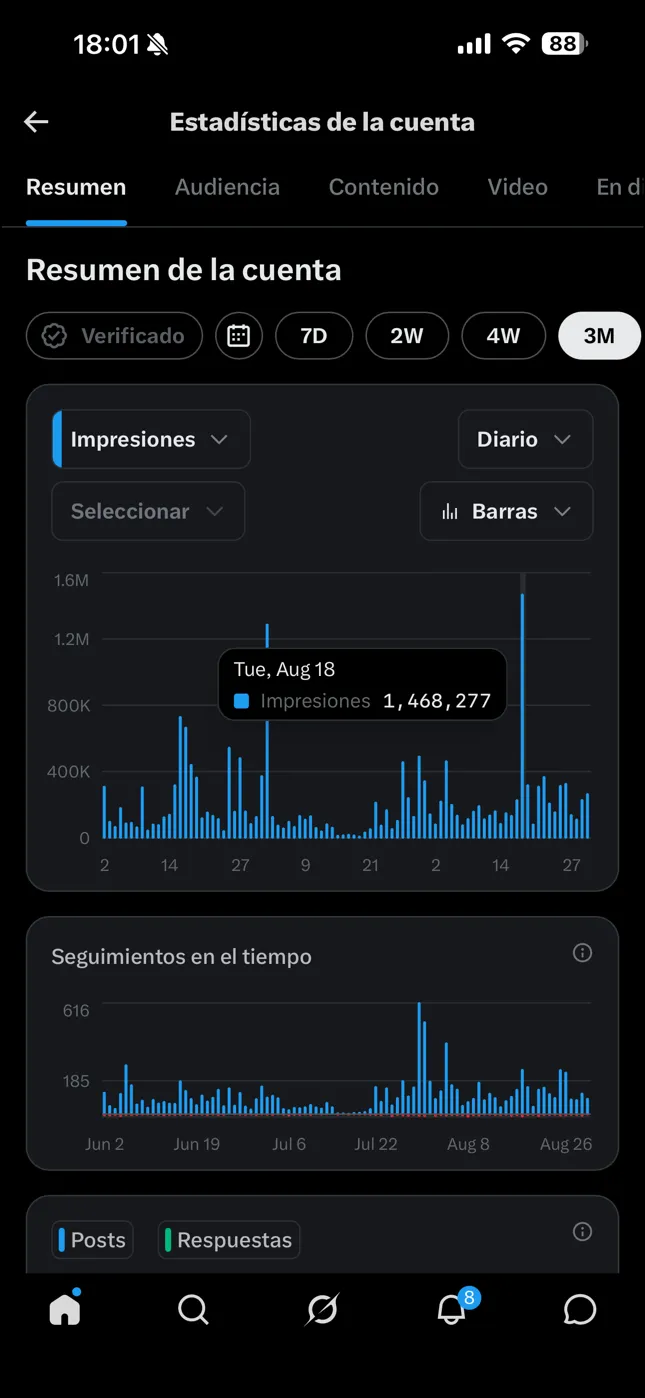
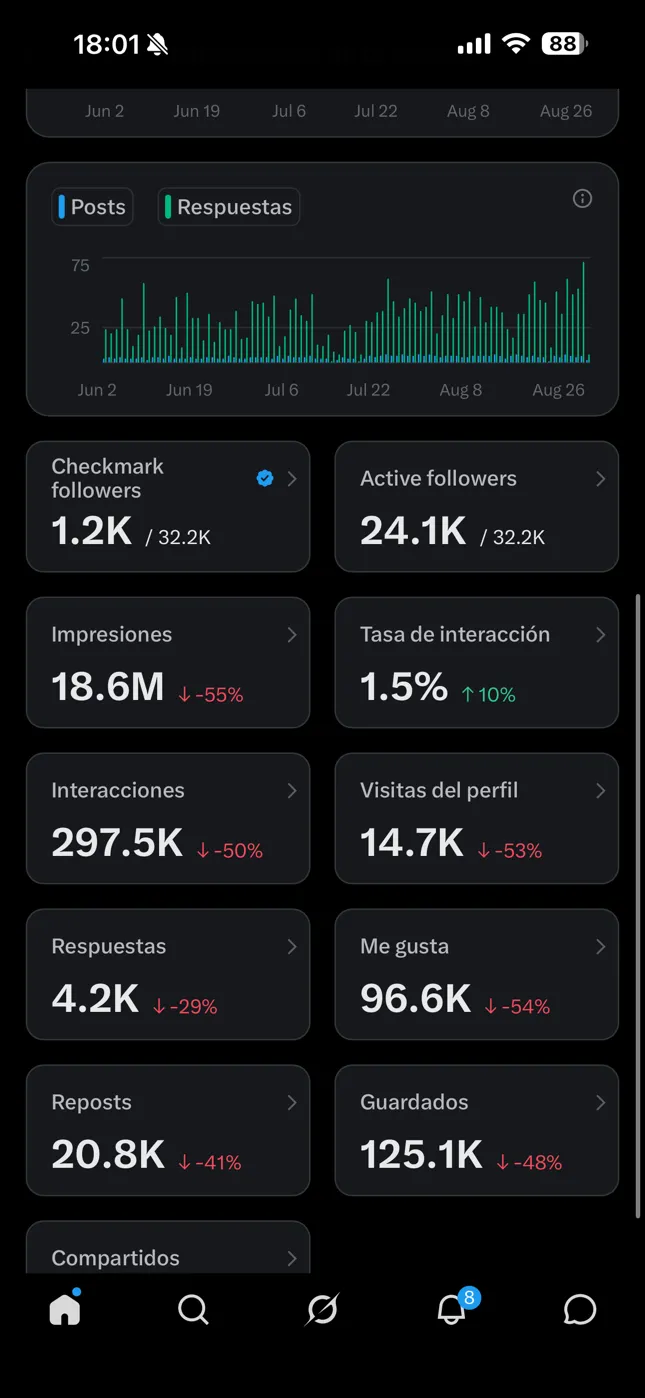
X, over three months: 18.6M impressions, 297.5K engagements, 125.1K saves, 20.8K reposts, 96.6K likes, 4.2K replies and 14.7K profile visits, with a 1.5% engagement rate. Of my 32.2K followers, 24.1K are active. The biggest day was 18 August, with 1,468,277 impressions in a single day.
14. What nobody told me and would have saved me time
Everything above is the strategy. This is what I learned the hard way.
The profile converts better than the post. People read your post, go into your profile, and decide there. If your bio says “passionate about technology 🚀”, you have lost all of them: your bio has to say what you do, who for, and what they can do with you.
The first 30 minutes decide the post. The algorithms test with a small sample of your audience; if it works, they widen it, and if not, they bury it. That is why you cannot post and disappear: for the first 30 minutes you have to be answering comments.
One link only, and in the first comment. Every platform would rather people did not leave, so a link in the body of the post means less reach and a link in the reply means reach untouched. X has said this no longer hurts you, but who knows…
Do not post more, post better. Posting 15 times a day sets off “not interested”, which subtracts 43.2 on their table. I have had better weeks posting three times a day than ten.
Not everything that works for somebody else will work for you. A colleague with over 30,000 followers told me carousels had brought him loads of followers. I have tried four or five and so far, nothing. It does not mean he is lying or that carousels do not work: it means his audience is not mine. Try what people tell you, but decide with your numbers, not theirs.
Save everything that works. Every post that goes past X impressions goes into a document with its hook, its date and its numbers. In three months you have your own manual, better than any guide anybody sells you. This article is literally that.
Do not compare platforms by their numbers. A Threads view, an X impression and an Instagram reach are not the same unit, not even close. Add them up if you want a headline, but do not make decisions with that sum.
Followers are not the goal. I have 32,200 followers on X, but what matters to me are the 14,600 profile visits over the last 90 days: those are the people who wanted to know who I am. That is the real number.
Boring is what wins. Posting every day for months, no exceptions, without waiting for the perfect post. 90% of my posts do not reach 20,000 impressions. The ones that reach 1M come from carrying on posting the ones that do not.
And burnout is real. Write in blocks: I spend an hour every morning scheduling the 4-5 posts for X and Threads, and a bit more in the afternoons on Instagram content, and I am dying to hire an editor to save me that extra time.
Summary
- Start gradually: faceless, with your name, from behind, talking. Four steps, not one jump
- Teach, do not show off. Nobody cares about your life; everybody cares about what you know
- Copy 50%, from trends and from other languages, always changing something. The other 50%, be yourself
- Replies are worth ten times more than likes, and being shared by copy link, forty. It is in X's own code: write to be replied to and to be forwarded
- Comment on 10 big accounts in your niche every day, with three or four lines that add something. That is where the free visibility is
- Four lines of hook, red emoji, a promise and an arrow. And reuse the ones that work
- Combine TOFU, MOFU and BOFU. Viral without sales is an expensive hobby; sales without viral is a whisper
And above all: post today. I have been four months on X, six weeks on Threads and three weeks on Instagram. Four months ago I had nothing. The best time to start was yesterday and the second best is today.
Thank you genuinely for making it this far, I know it has been long. If any of this helps you, I would love you to tell me: what you tried, what worked and what did not.
Remember that everything I make is free, my income comes from elsewhere. I do it because I need to write my thoughts down, share them and help other people.
I always think about myself when I decided to go out on my own for the first time. Nobody helped me, but I would have loved to have that person who helped me and saved me time I will never get back.
I hope to be that person. Every hour I can find, I will put into helping you.
Thanks for reading! Do not forget to follow me on Instagram (if you liked the content)! ❤️